Ninja’s ability
Ninja’s ability
- Running ability
- Jumping power
- Ki-Qigong control, Breath control, Sprit cultivation
- Accent idiom, Dialect
- Lip reading, Mind reading
- Disguise
- Memory
- Ninja’s own tactics

Running ability
Horses were the fastest means of transportation during the time when ninjas were active and highly regarded. While horses can run swiftly on smooth roads, it is said that humans can outrun horses on rough and uneven terrain.
A ninja’s primary mission was to gather intelligence on their opponents for the feudal lords they served and deliver it back, rather than engaging in direct combat. Their top priority was to ensure that secret information reached the master who had hired them. Running ability was primarily needed for escaping.
As long as a ninja remained outside the reach of an opponent’s sword or spear, they could stay safe, provided their speed exceeded that of their pursuers. Even if an opponent wielded a bow, arrow, or firearm, a ninja could still evade danger as long as they moved fast enough to prevent being accurately targeted.
During a time when signal fires were the fastest method of communication, human running ability was an essential means of transmitting messages over short distances.

Speaking of a ninja’s running ability, it is said that they could run an estimated 160 to 200 km per day on average. Records from the Edo period show that express messengers were able to cover 200 km in a single day. Based on this, we might consider 160 to 200 km a reasonable estimate.
Additionally, ninjas were said to run at speeds of 15 to 16 km per hour. These figures are based on their travel along the so-called ‘ninja roads,’ which passed through mountainous terrain, utilizing beaten paths created by animal footsteps.
Ninjas used two types of waraji (straw sandals): one was a half-size version called Ashihan, and the other was a standard-sized version. The Ashihan was designed with an open sole under the arch of the foot to prevent pebbles from getting inside. This design allowed ninjas to run more easily.
For this reason, the running style known as ‘Namba run’ utilizes a unique movement that connects the lower and upper halves of the body. It contrasts sharply with modern running techniques. You can find demonstrations of Namba run on YouTube.
There is a report stating that a small and previously weak high school basketball team managed to qualify for the National Championship of Japan by incorporating Namba run into their training.
If we estimate maximum running speeds, Usain Bolt has been recorded running at 45 km per hour, while professional soccer players typically reach speeds of around 38 km per hour. Ninja might be able to run 40km per an hour at the top speed on a normal road.
It is assumed that ninjas trained in running as an essential skill every day from childhood. As long as a ninja possessed strong running ability, they would at least have been given a job as a courier.
Regarding running training, there is a record stating that ninjas ran while carrying a small tray on their chest without dropping it or tied their kimono sash around their hips in a way that prevented it from touching the ground.
Jumping power
Jumping power is a key difference between a ninja’s abilities and those of ordinary people. There is a well-known story that ninjas would first sow hemp seeds in the soil and begin training by jumping over the sprouts. As hemp grows rapidly, ninjas had to continuously jump higher as the plants increased in height. Through this training, they developed exceptional jumping ability.
Mr. Yumio Nawa (1912–2006), a martial artist and historical researcher, estimated that the average high jump of a ninja could have been around 2.7 meters. This height far exceeds the world record for the high jump, which is 2.45 meters.

It is believed that the primary purpose of a ninja’s high jump was to scale fences. By leaping high enough to grab the top of a fence, a ninja could then pull themselves up and over.
Karasawa Genba, a famous Sanada ninja, is said to have jumped 1.8 meters high from a standstill and landed silently after jumping from a height of 12 meters. Assuming he was 160 cm tall, he could have easily grabbed the top of a fence.
Yu-pon thinks that Parkour, which was developed in France, resembles ninja movements. I recommend watching Parkour videos on YouTube to see the similarities.
Ki -Qigong control, Breath control, Spirit cultivation-
According to Mankawashukai, the most famous guidebook on the ninja arts of Iga, a ninja’s work can be divided into Yonin and In-nin. Yonin means to act positively by openly revealing oneself to the opponent, while In-nin means to act negatively by operating in secrecy and concealing one’s presence during missions.
In In-nin missions, even sensing the presence of someone could lead to a fatal outcome. Many samurai possessed exceptional sword skills and had mastered qigong control. If a ninja on an In-nin mission failed to regulate their breathing, spiritual energy, and qigong techniques, they would be discovered or killed by a samurai. So, Mankawashukai warns that samurai are extremely dangerous, and advises that ninjas should flee if they ever encounter one.
There is also a story about Uncle Nick’s great-grandfather. He was a samurai serving the Maeda Domain and taught kendo (Japanese swordsmanship) when the Meiji era began. He told his child (Uncle Nick’s grandfather) that when fully concentrating, he could hear the sound of a needle falling to the ground from 8 km away.
Morihei Ueshiba, the founder of Aikido, once encountered horse-mounted bandits in Manchuria. It is said that he dodged a bullet simply by looking at it as it was fired by the bandits.
A similar story recounts how a Vietcong soldier managed to duck and dodge a bullet fired from a Colt Government pistol by U.S. soldiers.
In traditional Japanese martial arts, practitioners had to react to attacks from behind, execute combat techniques in complete darkness, and fight multiple opponents simultaneously. This suggests that qigong control, breath regulation, and spiritual cultivation were essential skills.
By principle, ninjas had to practice qigong and spiritual cultivation in such situations.
Modern science explains that Ki is related to a weak electric field—an area where electric power is active—that surrounds the human body. This is known as a quasi-electric field, which originates from within an electrical field called bioelectric potential.
The body of any living creature, including humans, acts as an antenna within this electric field. The state of this quasi-electric field shifts in response to human body movements.
While walking, the state of the electromagnetic field fluctuates due to variations in the shape of footsteps around the contact area or the exchange of electric charge with the ground.
Humans are said to have the ability to sense changes in electric fields (known as Kehai or Ki) through their inner ears or body hair.
For a swordsman, it is crucial to launch a proactive attack by sensing Ki through the opponent’s eyes and muscle tension, all while maintaining control over their own Ki to avoid provoking an attack from the opponent.
It can be said that ninjas and samurai were required to develop the ability to perceive such environmental changes using Ki information and to assess situations through their eyes and ears.
During an In-nin mission, when infiltrating an opponent’s castle or a samurai residence, a ninja had to move with absolute silence and carefully suppress their Ki.
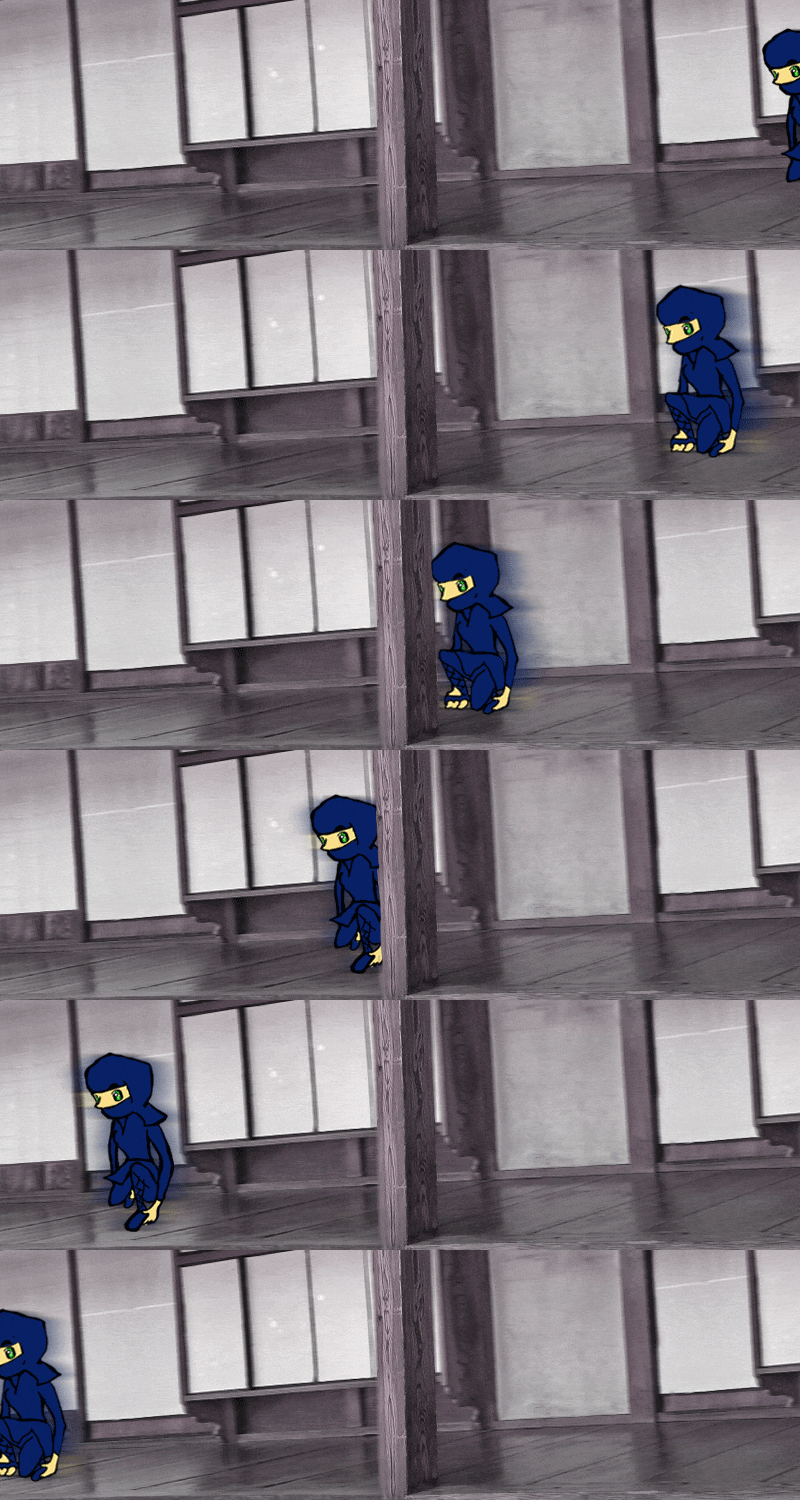
Among the unique walking techniques used in In-nin missions, some notable methods include the fox walk, the dog’s road, and the hare steps on a grass board. The fox walk refers to stealthy movement, while the dog’s road involves walking under eaves, along trees, or over stones—common places for quick concealment.
When moving through a corridor, ninjas would employ the hare steps, placing their hands first like legs and then following with their feet onto their hands, mimicking the movement of a rabbit. This technique enabled them to walk silently on wooden corridors, proving most effective when moving along the edges.
When an opponent approaches, a ninja must use the techniques of Kannon Hide or Quail Hide to erase their presence. Kannon Hide is a technique where a ninja remains motionless, silently reciting the Kuji-kiri of Ingei (a symbolic hand sign) in their mind.
To maintain distance from battle, they position themselves close to fences or garden trees and raise their sleeves to cover their entire face—except for their eyes. While ensuring that even their breathing remains silent, they face away from the opponent’s direction.
Quail Hide is a technique in Iga Ninja art where the practitioner mimics a stone by silently reciting the Kuji-kiri of Ingei in their mind, pulling their neck back, tucking in their arms and legs, lying face down, and remaining motionless.
Ninjas often recite the Kuji-kiri of Ingei because this practice is essential for initiating deep mental concentration.
It was a routine technique used by ninjas to erase any trace of their presence in the air. For In-nin ninjas, it was crucial to maintain an air-like existence to the enemy by eliminating all signs of their presence.
Infiltration Techniques and Language Adaptation
Ninjas had to speak the local dialect of the region they infiltrated; otherwise, the local people would become suspicious of them. Japan has a wide variety of dialects, and mastering them was a difficult task.
However, to blend in with their surroundings, ninjas learned the art of disguising themselves as various professions, such as Komuso (mendicant Zen priests of the Fuke sect), street performers, medicine peddlers, mountain priests, Sarugaku actors (a form of theatre popular in Japan from the 11th to 14th centuries), and shrine maidens.
Ninjas specifically chose these professions because they did not require them to speak in the local dialect, making it easier to maintain their cover.
Lip reading and mind reading
Lip reading was very effective way to collect enemy’s information in one’s eyesight. Also lip reading was used as communication tool in the same group in case of talking to someone nearby. And Mankawashukai (legendary record of locals) explains the other important art for Ninjutsu which was the technique of observing people by way of divination obtained from people’s facial features and atmosphere told from the appearance of the opponent’s.
Artistic Disguise Techniques
Nobody knew the true faces of Iga Jōnin ninjas, such as Momochi Sandayu and Fujibayashi Nagato. They constantly maintained their disguises, ensuring that their real faces remained unrecognizable to all. There was a group of ninjas who specialized in disguise techniques and worked as intermediaries or trainers in the art of deception.
Memorial power
Ninjas infiltrated enemy territories to gather crucial information, including locations, route maps, facial features of key persons, sketched maps of castles, and other designated items. Although ninjas obtained a vast range of intelligence, they primarily relied on their memory, carrying back minimal written records.(It would be a serious issue if one’s notes were stolen.)
Ninja’s own tactics
Ninjas who were not Ninshi (samurai ninjas) were ranked 18th out of the 20 levels in the military hierarchy. Because of this, they never learned samurai swordsmanship.
Instead, they developed their own unique weapons. These included sickles, sickles connected to chains, sword-stick canes, and blowguns, which they utilized in their distinctive, eccentric attack techniques.
Since the primary purpose of ninjutsu was enemy intelligence gathering, these attacks were not intended for direct combat but rather served as techniques for escape and survival.