Famous Group :Koka
甲賀衆 Koka ninja
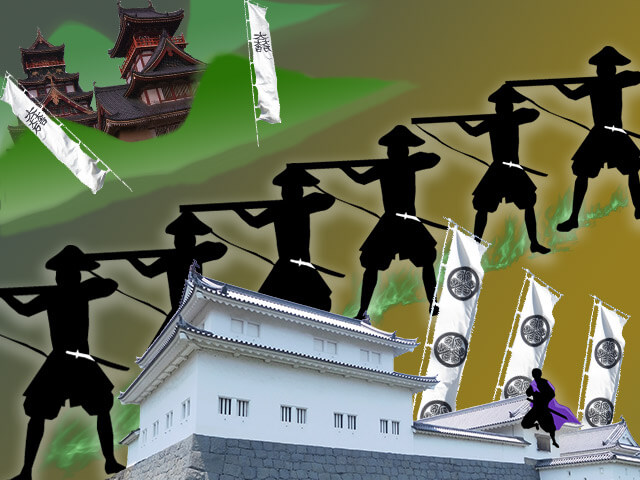
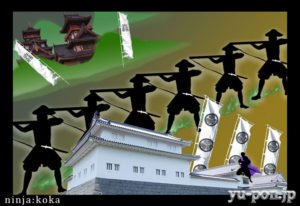
From Iga’s perspective, Koka is located on the other side of the mountain range, approximately 50 km away from Kyoto in a straight line.
Groups of small feudal lords or wealthy farmers, who farmed in the morning and trained as ninjas in the afternoon, united under the bloodline-based association known as Domyochu. Together, they formed a highly independent community called ‘Sou,’ which consisted of people without a feudal lord but with strong local bonds. One of the most distinctive features of Koka society was its approach to problem-solving. They valued a discussion system among selected leaders from 53 family clans—known as Kōka Gojūsan-ke (甲賀五十三家)—a governance structure that was unparalleled in other regions during the Sengoku period (Warring States Period).
Koka ninjas gained renown during the Battle of Magari between 1487 and 1489. This conflict saw Ashikaga Yoshihisa, the ninth shogun of the Muromachi shogunate, lead an army of 20,000 soldiers in an attempt to defeat Rokkaku, the ruler of the Koka region, a rural area located away from Kyoto.
The Koka ninja groups successfully aided Rokkaku by turning all battles into guerrilla warfare in the mountains and carrying out night attacks. They won every battle and eventually defeated the Ashikaga forces.
Ashikaga Yoshihisa was reportedly afflicted by an illness and later died from a wound sustained in a previous battle. The war left a lasting impression on people across Japan, showcasing the brilliance of ninja tactics—where fewer than 100 ninjas skillfully fought against 20,000 soldiers and emerged victorious by leveraging mountainous terrain and the cover of night mist.
It was an amazing battle in which only 100 ninjas harassed an army of 20,000 soldiers and ultimately defeated them. This event led people in Japan to recognize the existence and formidable skills of ninjas.
The Tomo group, one of the leading ninja families among Koka’s 53 selected families, descended from foreign settlers and possessed extensive knowledge of medicine. Their expertise in pharmacology led to the production of herbal medicines in Koka, which were then distributed to other regions by traveling merchants.
At the same time, Koka ninjas excelled in performing wazuma, a traditional Japanese magic. It is natural to assume that wazuma techniques, such as illusionary arts, disguise tricks, and instantaneous effects, were incorporated into Ninjutsu. The famous Nomma-jutsu, in which a performer appears to swallow a horse, was said to have been used by legendary figures like Tobikato (Katō Danzō, a skilled ninja of the Sengoku period) and Kashin Koji (a master illusionist of the late Muromachi period). Even in the Edo period, wazuma performer Shiotani Chōjirō was known to have used this technique.
Donba, a ninja trick in which a performer appears to swallow a horse or cow, was used by Flying Katō (Katō Danzō, a skilled ninja of the Sengoku period) and Kashin Koji (an illusionist at the end of the Muromachi period). Chojiro Shioya, a wazuma master of the Edo period, also employed this swallowing illusion technique.
Today, traditional wazuma techniques can be seen in their modern form on YouTube.
Ninjas in later times…
During the Sengoku period, Koka’s name spread to other regions as they began sending soldiers to neighboring battles on a hire basis. These decisions were made solely through council meetings among selected members.
Unlike the Iga clan, Koka placed themselves under Nobunaga’s protection instead of supporting anti-Nobunaga factions. Later, they subordinated themselves to Hideyoshi, and their lands were confiscated (Kaieki).
After Kaieki, most Koka samurai transitioned to the status of bushi, while many ninjas spent the rest of their lives as farmers. One prominent Koka ninja, Takigawa, rose to the rank of feudal lord due to his superior firearm skills.
During the Tokugawa period, Koka warriors served as gunfighters for the shogunate.
Uncle Nick think of …condition for supporting Ninja art and Ninja skill
Uncle Nick seems to be considering the following as conditions for establishing ninja arts and skills as a profession in the Iga and Koka regions during the Sengoku period.
- Although the Kii Peninsula is close to Kyoto, feudal lords were unable to invade the region. This was because its central area was divided by mountain ranges, and the lower part had strong ties to the Imperial Family due to the presence of Buddhist temples and sacred sites for Shugendō, which had existed there since the Heian period.
- Speaking of the political climate in Koka, they had an assembly and governed themselves. This assembly consisted of a samurai-led group, which could be classified as armed farmers who gathered to establish a collective decision-making system. For this reason, strategic planning and tactics tailored for guerrilla warfare in the mountains, night raids, and intelligence operations were essential to defend their land. Since these conditions demanded specialized combat skills, ancient swordsmanship and unique techniques evolved—ultimately giving rise to Ninjutsu, the martial art of the ninja).
- Securing revenue from occupations beyond farming, such as serving as hired soldiers, was crucial for economic reasons. This necessity may have further contributed to the flourishing of Ninjutsu, as warriors sought specialized skills to sustain their livelihoods.
- Because the area was close to a trading port with foreign countries, opportunities to encounter inventions and technologies from abroad were greater. For this reason, people from Koka were quick to apply their knowledge of medicine and adopt new weapons such as guns, cannons, and explosive powder in their daily practices. Illusive Ninjutsu techniques, such as body-splitting illusions, may have been developed based on the idea that even a smaller entity could overcome a larger one.