History
Short story for Ninja history
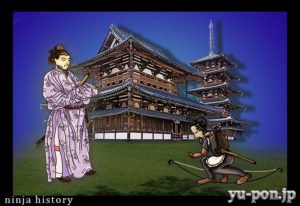
It is said that Ninja historically came into existence about 1,400 years ago. According to records, Prince Shōtoku hired Ootomo Hosohito as a Shinobi (the original term for Ninja), utilizing espionage techniques to monitor enemy movements. He then successfully defeated the enemies using a form of Ninjutsu (Ninja’s art) known as ‘Sun-Tzu’s Yoma (gap).
Prince Shōtoku (Crown Prince) was the first to introduce Buddhism to Japan and laid the foundation for the Yamato Dynasty. He also granted the Hata family (Hata-uji), originally from the Shilla people, an important position. Later, the Hata family settled in the Iga and Koka regions and passed down Ninjutsu to the locals.
Ninja activities became known during the Nara period (710–794), emerging alongside the establishment of the manorial system. In medieval Japan, life centered around rice cultivation within these estates.The lords of these manors included powerful families, the nobility, Shinto shrines, large temples, and the Imperial family. The people without land were called“ Akutou” means a blackguard or scoundrel protected these manorial system.
The activities of the ‘Akutō’ developed into the foundation of the Ninja’s role. A Ninja’s work was essentially that of a spy, gathering intelligence on enemy estates. This occupation was traditionally carried out by farmers or monk warriors from large temples, rather than by Samurai.
Tasks such as night raids and covert support operations performed by Ninja were not compensated with land grants, unlike the rewards given to Samurai for their service. However, during the later Sengoku period (Warring States Period, 1467–1590), many daimyō (feudal lords) began hiring Ninja based on their accomplishments. Those who demonstrated strong leadership skills were sometimes recognized as ‘Ninshi’—low-ranking Samurai Ninja.
Moreover, the knowledge passed down by Ninja covered a broad range of fields, including Kampo (herbal medicine), meteorology, medicine, mathematics, astronomy, divination, and literacy.

Written communication was essential, rather than oral transmission. Thus, the development of Ninja arts was not the work of illiterate farmers, but rather the contribution of literate mountain priests and monks of Shugendō, a Japanese ascetic tradition blending Shinto and Buddhist concepts.
Speaking of Shugendō, its temples were abolished during the Meiji Restoration when a government ordinance mandated the integration of Shinto shrines and Buddhist temples. As a result, the number of followers, once around 240,000, declined drastically, and today, the majority of Japanese have little knowledge of mountain worship that incorporates Buddhist elements. In other words, no one is truly able to discuss the reality of Ninja in connection with Yamabushi (mountain priests) anymore.
Let’s take a look at the area around Kyoto, which was the capital until the Meiji Era. Its narrow valleys are separated by rugged mountains. In fact, mountain ranges, hills, and plateaus cover three-fourths of the Kyoto region. This means that mountain ridges often served as the front lines of battle against opponents. Here, you can see the strategic importance of battle lines drawn within the mountain ranges.
The flourishing of Ninja arts was based on three key factors: first, the connection with Shugendō, which provided survival skills; second, the new technologies and intelligence brought from overseas—such as herbal medicine, firearms, and gunpowder; and third, the increasing demand for professional Ninja work. During the Warring States period, daimyō from across Japan formed their own Ninja groups.
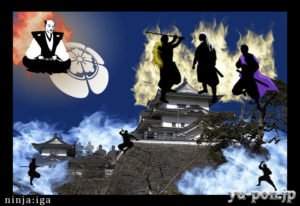
Historically, we must particularly recognize the Iga, Koka, and Togakushi (Sanada) Ninja groups for their incredible skills.