Sakura Viewing Spots ① Yoshino Mountain
Sakura Festival ① Yoshino Mountain

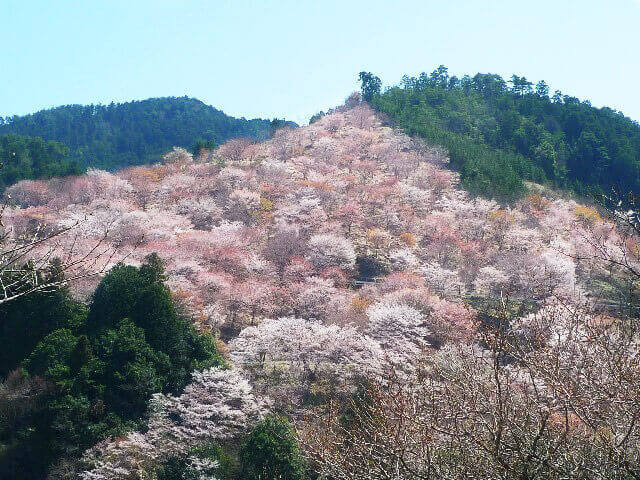


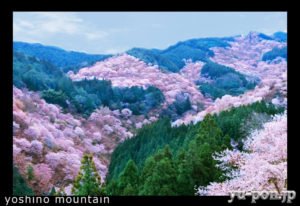
The cherry trees of Mount Yoshino are mainly of the Shiro-yama-zakura variety (Castle-Mountain cherry), and over 35,000 trees have been counted. These trees grow across four areas: Shimosenbon (Lower Thousand Trees), Nakasenbon (Middle Thousand Trees), Kamisenbon (Upper Thousand Trees), and Okusenbon (Deep Thousand Trees). In April, Mount Yoshino will be celebrated in pink, starting from the foot of the mountain and eventually covering the entire slope.
There is a historical sakura legend about En no Gyoja (634–701), a mystic known as the founder of Shugendo—a religious tradition rooted in mountain worship and Yamabushi asceticism.
In the 7th century, while meditating on Mount Yoshino, En no Gyoja received a divine revelation from Zao Gongen, an incarnation of the Buddha.
He carved the image of Zao Gongen into a sakura tree board.
Since then, the sakura tree has been treated as sacred and eventually regarded as a wooden symbol, much like a pagoda stand.
In fact, many yamazakura (mountain cherry trees) were donated to the area and planted from the foot to the summit—creating what is now known as Mount Yoshino, home to the “best thousand sakuras.”
Cutting sakura trees or breaking their twigs is strictly prohibited on the mountain.
Motoori Yorinaga, a scholar of Japanese classical literature, once answered the question “What is Yamato-damashii?” by saying:
“Yamato-damashii—the spirit of Japan and the samurai mind—is like a fragrant mountain cherry blossom in the morning sunlight.”
As long as you continue enjoying hanami under the Somei Yoshino cherry trees, you may not truly grasp the meaning of Motoori Yorinaga’s tanka—a 31-syllable Japanese poem.
The foot, middle, and upper thousand trees are all beautiful, but the deep thousand is a special place where one can experience Yamato-damashii through quiet reflection.
Starting from Kinpu Shrine, you walk along a steep, narrow path through the deep forest for about 40 minutes until you reach a wide-open ridge.
From there, you can overlook the divine and sacred Okusenbon (“Deep Thousand”), a layered landscape that stretches from the mid-slopes to the deep mountain.
A spring flows nearby. The cherry trees in Okusenbon are much taller than those in the more popular areas.
When the wind blows, their branches sway widely, and pink petals flutter down like a shower.
You find yourself quietly saying “Wow,” struck by how harsh the growing conditions must be.
And it just hits you—how strong and stunning these sakura are, quietly thriving in a place no one would expect them to grow.
Usually , Sakura trees usually bloom with flowers before their leaves appear, and the blossoms fall quickly—often before any leaves begin to grow. The sight of cherry blossoms scattering from bare branches leaves a graceful impression on the Japanese people.
It could be said that the Japanese spirit reflects the nature of cherry blossoms, casting their fleeting beauty onto human life, isn’t it?
Access
| Name; | Yoshino Mountain |
| Place; | Yosinoyama 2498, Yoshino town, Yosino County, Nara Prefecture |
| Access; | ・ from Nagoya to Yosino 2h 55min, take Kintetsu line (change at Kasihara Jingu-mae), ・from Osaka Area to Yosino 1h 15min, take Kintetsu line at Osaka-abenohasi (from Tennouji station 5min by walking), ・from Kintetsu Yosino station to Yosino Mountain, take a cable car at Senbonguchi (3min from Kintetsu Yosino station) to Santyou Yosino Mountain station. |
| By car; | ・ from Nagoya 3h, Higashi-Meihan expressway to Meihan National Road, exit at Hari R369.370 to Yosino ・from Osaka area 2h, Nisi-Meihan expressway via Kashihara R169 or from Hanwa expressway Mihara Jc via Road Minami –hanna Katuragi I.C,R165(Takada bypass)Kasihara then R169, 1h |
Yu-pon loves this place not only during the cherry blossom season, but also in autumn.
The colorful foliage of Mount Yoshino is perfect for enjoying “momiji-gari” (autumn leaf viewing), especially while hiking down the path from Kinpu Shrine to Yoshimizu Shrine. Mount Yoshino has been designated as part of a World Heritage National Park.
Within the park lies the famous ascetic training route, the Omine Okugake-michi—a spiritual pilgrimage path established for religious discipline—that stretches from Yoshino to the sacred forests of Kumano.
You’ll see relics, monuments, shrines, and temples related to Shugendō. There are also four World Heritage-designated National Treasures: Yoshimizu Shrine, Yoshino Mikumari Shrine, Kinpu Shrine, and Kimpusen-ji.
Yu-pon thinks that while many foreign tourists are fascinated by the ancient capital of Kyoto, most of them don’t know about Yoshino.
One of my favorite places is Kimpusen-ji, where three 7-meter-tall statues of Kingo Zao Gongen are enshrined. Their faces, coated in lapis lazuli blue powder, shine mysteriously in the darkness of Zaōdō Hall. At the sight of Gongen’s face, Yu-pon was deeply moved, sensing a tender warmth beneath the fierce expression —a feeling gently mixed with fear, loving-kindness, and compassion. At first glance, she felt a beauty full of energy—so tremendous and breathtaking!
In 1336, Emperor Go-Daigo established the Southern Imperial Court on Mount Yoshino, which was later moved to Anou (賀名生) in 1348. This is where traces of the ancient capital can still be observed.
Additionally, several ryokan in the area offer public access to onsen baths. If you’re lucky, you can enjoy views of the mountain’s pink or red hues while soaking in the onsen.